This was Thursday: 1968 Compare and Contrast

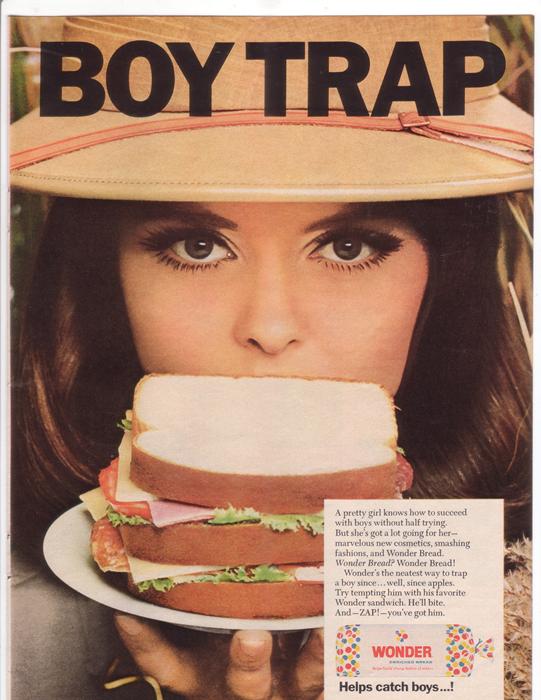
boy trap

adding fuel to now’s fire and no doubt making betty friedan’s hair stand on end
1968 Wonder bread ad

The boys on Madison Avenue were having a field day in 1968: not only were social mores changing and a whole new demographic of consumer coming up through the ranks but the field of advertising itself was quickly learning to capitalize on the trends. Women’s liberation was in its infancy despite how many of the gender felt but stereotypes in the media were still commonplace – in a paradox of epic proportions one can almost hear mothers across the nation calling out to their daughters to take some sandwiches along to the protest  – ” Be brave, stay away from the police and make sure Bobby gets one of those ham ‘n’cheese!” Promoting old products in a modern light was, to make a bad pun, the bread and butter of the business but one couldn’t help but wonder the manner in which some of the agencies ‘borrowed” wholesale from the earlier success of groundbreakers in the fields of music and art.
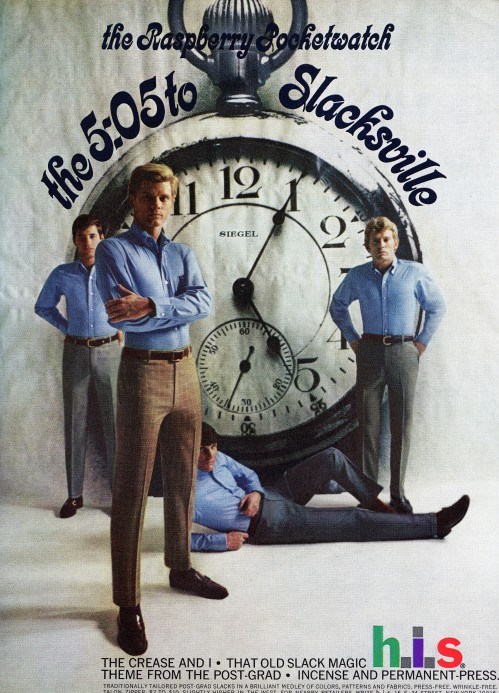
1968 his ad

cool guys in charge in slacks their wives and mothers bought
1968 h.i.s. AD

Industry could hear the sound of cash flowing into their coffers with the right campaign – someone in the PR department of Campbell’s did and took back the can Andy Warhol had made iconic with its very own beach-bag mail-in offer. Now everyone could own a piece of pop art or look like the latest pop star all the girls were giddy over.

Not much has changed, except for the legal concept of Intellectual Property

Read more about 1968:

NOW
Wonder Bread
1968
1968 JukeBox

This was Thursday: 1968

classical gas in a time of chaos

As much as the flower children hoped for peace on earth, the chances of achieving it in 1968 were slim. The world was still in the grips of the Cold War when in an unprecedented move North Korea seized the US Navy ship Pueblo and held 83 on board as spies in a drama that would take 11 months to resolve.  During that period the Soviet Union invaded Czechoslovakia, the North Vietnamese and Viet Cong troops launched the Tet offensive and in one of the most horrific atrocities in American military history soldiers massacred over 300 civilians at My Lai.

Social unrest manifested all over the world – the issues that Martin Luther King Jr. had fought so hard to bring to the forefront became that much clearer on April 4 when he was shot down while standing on the balcony of a motel in Memphis, Tennessee by James Earl Ray. As news of the assassination spread, violence broke out in cities nationwide. This and the ongoing “Poor Peoples Campaign” that King had had a guiding hand in organizing gave President Lyndon Johnson the necessary impetus to sign the Civil Rights Act of 1968. Murder of public figures did not end with King, less than two months later Sen. Robert F. Kennedy was shot and critically wounded in a Los Angeles hotel after winning the California primary and died June 6.

stop series

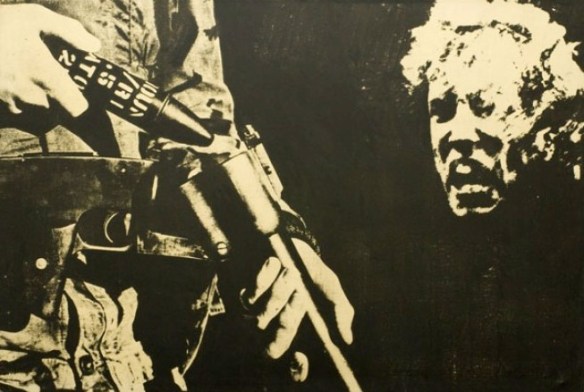
A painting inspired by contemporary political events from the STOP series by Peter Kennard

The young and disenfranchised everywhere felt the pinch of authority – in May the Paris Student Protest triggered a nationwide crisis and was followed by a month of protest by the National Labor Unions which shut down the Sorbonne, paralysed communication and transportation network and brought the country to a virtual standstill. In one of the largest protests in a single city, 800,000 teachers, workers and student protesters marched through the French capital during a one day general strike. War-weary Americans must have taken note of how numbers could elicit change for later that summer anti-War protesters mobilized against the Police in a street battle at the Democratic National Convention in Chicago.

Despite the chaos some success was achieved throughout the year – the first manned mission Apollo 8 orbited the Moon restoring hope in the space programme, the invention of amniocentesis made advances in reproductive science and the Emergency 911 Telephone service was started in the USA. Proving once more that England could export more than Rolling Stones and Beatles chart-toppers, Reg Varney, the comedian, in a nice bit of publicity used one of the first ATM machines at Barclays Bank in North London, they would soon crop up all over the US.

In 1968, Andy Warhol coined the expression that would become an enduring concept for generations then unborn – “In the future, everyone will be world-famous for 15 minutes.” He would have laughed if he knew how true his words were to become…

Read more on:

Mason Williams
Peter Kennard
1968
1968 JukeBox